 Bexora
Industrial artificial intelligence is moving from experimental laboratories into factory floors, warehouses, power stations, and transport networks. As this transition accelerates, choosing the right industrial AI server manufacturer becomes a serious technical and commercial decision. A server may look impressive in a product brochure, yet fail under dust, heat, vibration, or continuous inference workloads.
This article examines China’s top 10 industrial AI server manufacturers and the capabilities that separate them. The comparison considers GPU and accelerator support, edge deployment, thermal design, industrial connectivity, cybersecurity, customization, supply stability, and after-sales service. These factors matter when a system must inspect thousands of products daily or process sensor data with minimal delay. Jensen Huang, NVIDIA’s founder and CEO, has stated, “AI is the most powerful technology force of our time.” His observation reflects the scale of this change, but hardware still determines how reliably that power reaches real operations.
The selected companies may include established server brands, intelligent manufacturing specialists, and solution providers with strong domestic integration experience. Not every supplier excels in every category. That is important. Some offer better computing density, while others provide stronger edge engineering or project support. Rankings can also change quickly as chips, software ecosystems, and industrial requirements develop. Readers should therefore treat this list as a practical market guide, not an unquestionable verdict. The strongest industrial AI server manufacturer is ultimately the one that fits the workload, environment, budget, and long-term maintenance plan.
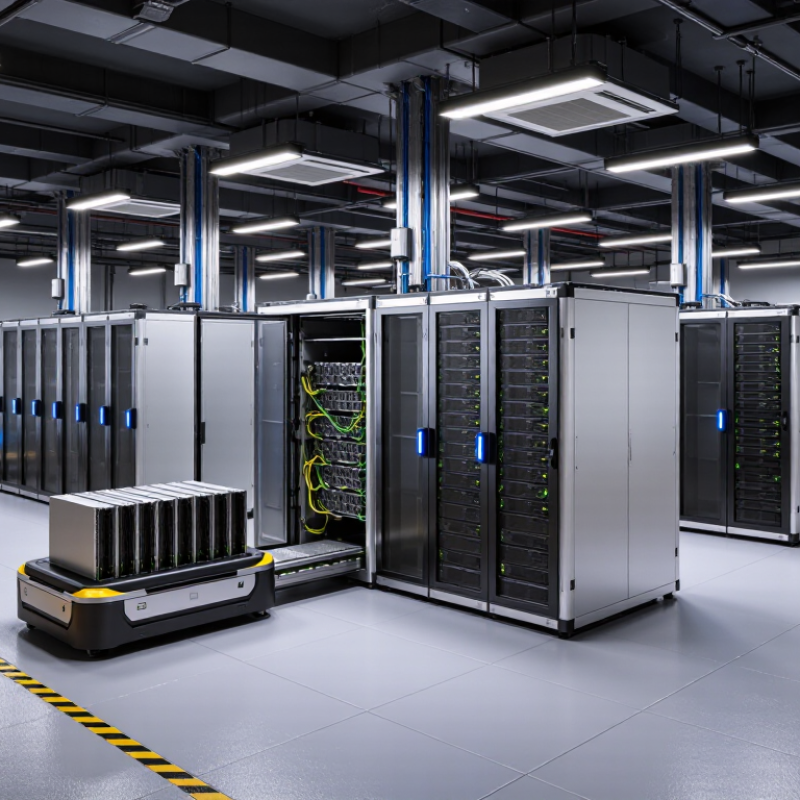
What Defines an Industrial AI Server Manufacturer in China?
An industrial AI server manufacturer does more than install powerful processors. It designs systems for factories, ports, energy sites, and transport networks. IDC forecasts global AI infrastructure spending will reach 154 billion dollars by 2028. That growth raises the standard for Chinese manufacturers. Their systems must deliver stable inference, fast data transfer, and predictable maintenance.
Reliability starts with physical design. A credible manufacturer supports ECC memory, redundant power supplies, dust protection, vibration control, and extended temperature operation. Cooling also matters. Uptime Institute’s 2024 Global Data Center Survey identifies power and cooling resilience as continuing operational concerns. In a factory, one thermal alarm can stop a production line. That is not a laboratory detail.
Evidence matters more than impressive specifications. Manufacturers should provide MLPerf-style throughput results, latency figures, failure testing, and clear service-level procedures. They should also explain firmware updates, spare-parts availability, and cybersecurity controls. A server that performs well for ten minutes proves very little. Field experience reveals more. Yet evaluations can become too neat; benchmark results rarely capture oil mist, unstable networks, or careless installation. A serious manufacturer acknowledges these gaps and tests them openly. That honesty is part of industrial competence.
The following comparison uses anonymized manufacturer profiles rather than company or brand names. Rankings indicate representative market positioning based on industrial deployment capability, system integration, accelerator support, reliability, and service coverage.
| Market Position | Anonymized Manufacturer Profile | Primary Industrial AI Strength | Typical Server Form Factor | Accelerator Support | CPU Platform Options | Industrial Reliability Features | Typical Operating Temperature | Compliance and Quality Practices | Common Deployment Scenarios |
|---|---|---|---|---|---|---|---|---|---|
| 1 | Manufacturer Profile 01 | Large-scale AI training, inference, and industrial data-center integration | 4U and 8U rack servers with high-density GPU capacity | Multi-GPU configurations using data-center or professional AI accelerators | x86 server processors; selected configurations support dual-socket platforms | Redundant power supplies, hot-swappable storage, remote management, ECC memory | Typically 10°C to 35°C in controlled data-center environments | CCC-related product compliance, ISO 9001 quality management, EMC testing | Smart factories, industrial vision, digital twins, centralized model training |
| 2 | Manufacturer Profile 02 | Industrial edge computing and real-time machine-vision inference | 1U, 2U, short-depth, and wall-mount edge systems | Low-power inference accelerators, GPU modules, and AI accelerator cards | x86 and ARM-based embedded server options | Fan monitoring, dust-resistant chassis options, watchdog functions, optional redundancy | Approximately 0°C to 50°C for standard edge configurations | EMC, safety, environmental, and factory acceptance testing according to application needs | Robotic inspection, production-line cameras, warehouse automation, AGV coordination |
| 3 | Manufacturer Profile 03 | High-performance computing for simulation, engineering, and industrial research | 4U GPU servers and scalable rack clusters | Multiple accelerator cards with high-speed interconnect and large memory capacity | Dual-socket x86 platforms with high memory bandwidth | High-airflow cooling, thermal monitoring, ECC RAM, RAID, and cluster management | Usually 10°C to 35°C under recommended data-center conditions | ISO 9001 processes, component validation, burn-in testing, and reliability screening | CAE simulation, semiconductor design, energy modeling, and scientific computing |
| 4 | Manufacturer Profile 04 | Domestic AI software and hardware integration for industrial customers | 2U and 4U rack servers with configurable accelerator bays | Support for domestic and international accelerator ecosystems, subject to software compatibility | x86, ARM, and selected domestic server CPU architectures | Validated drivers, BIOS customization, secure boot options, centralized monitoring | Commonly 5°C to 35°C in standard deployments | Software compatibility validation, information-security controls, and product traceability | Government-linked industrial projects, manufacturing analytics, localized AI platforms |
| 5 | Manufacturer Profile 05 | Ruggedized AI computing for outdoor, mobile, and harsh industrial environments | Compact rack, vehicle-mounted, fanless, and shock-resistant chassis | Embedded GPUs, low-power inference modules, and compact accelerator cards | Embedded x86 and ARM processors | Vibration resistance, wide-voltage input, sealed chassis options, and extended-temperature components | Approximately -20°C to 55°C, depending on configuration | Application-specific vibration, shock, ingress-protection, EMC, and environmental testing | Mining, ports, rail transport, energy sites, field inspection, and mobile command systems |
| 6 | Manufacturer Profile 06 | AI-enabled storage, video analytics, and industrial data management | 2U to 5U storage servers with GPU expansion capability | Inference accelerators and GPUs for video processing and analytics workloads | Single- or dual-socket x86 server platforms | RAID, hot-swappable drives, redundant fans, redundant power, and data integrity checks | Typically 5°C to 35°C in controlled facilities | Storage reliability testing, data-security controls, EMC compliance, and quality audits | Factory video monitoring, predictive maintenance, safety analytics, and industrial archives |
| 7 | Manufacturer Profile 07 | Private-cloud AI infrastructure and industrial virtualization | 2U and 4U general-purpose rack servers | GPU passthrough, virtualized accelerators, and inference cards | Dual-socket x86 processors with large memory configurations | Remote management, live monitoring, redundant components, and virtualization certification | Generally 10°C to 35°C for data-center operation | ISO 9001 practices, cloud-platform compatibility testing, and cybersecurity hardening | Industrial private clouds, AI development platforms, MES integration, and data lakes |
| 8 | Manufacturer Profile 08 | Energy, telecommunications, and distributed industrial edge infrastructure | Short-depth 1U/2U systems and telecom rack platforms | Low-power AI modules, inference cards, and integrated vision accelerators | ARM and x86 processors designed for distributed deployments | DC power options, remote boot, redundant networking, compact cooling, and field replaceability | Often 0°C to 50°C; extended-temperature options may be available | Telecom EMC, electrical safety, environmental, and network-equipment testing | 5G edge sites, substations, oil and gas facilities, smart buildings, and remote plants |
| 9 | Manufacturer Profile 09 | Industrial automation, robotics, and localized real-time control | Industrial box PCs, compact rack servers, and panel-mounted systems | Integrated AI modules and compact GPUs for low-latency inference | Industrial x86 and ARM processors | Long-life components, fanless options, DIN-rail or panel mounting, watchdog, and isolated I/O | Approximately -10°C to 50°C for selected industrial models | Industrial EMC, electrical safety, environmental durability, and lifecycle management | Robotic cells, PLC integration, quality inspection, process control, and machine monitoring |
| 10 | Manufacturer Profile 10 | Customized OEM and project-based AI server manufacturing | Configurable 1U to 8U systems, including custom chassis designs | Accelerator selection based on power budget, software stack, and customer workload | x86, ARM, and application-specific processor combinations | Customer-defined thermal design, BIOS configuration, lifecycle support, and burn-in testing | Usually 0°C to 40°C; rugged options can support wider ranges | Project-specific acceptance testing, traceability, EMC evaluation, and quality documentation | Specialized manufacturing lines, research institutes, transportation, and OEM deployments |
| Definition used: In China, an industrial AI server manufacturer is generally distinguished by more than GPU or CPU supply. Key indicators include industrial-grade thermal and mechanical design, accelerator and software compatibility, long-term component availability, remote management, deployment integration, compliance testing, and after-sales technical support. | |||||||||
Evaluate stable inference, maintenance access, thermal control, and service coverage. Processor counts are not enough. Test the server in real factory conditions.
Factory workloads reveal practical performance. Use identical datasets for vision inspection, predictive maintenance, and digital twins. Laboratory numbers may look better than reality.
Check accelerator compatibility, memory bandwidth, storage endurance, and network performance. Confirm that required cameras and sensors work together. Small details matter.
Run continuous inference for several hours. Monitor temperature, power use, fan speed, and performance changes. A server may throttle after an impressive peak.
Request power data during idle, normal load, and full inference load. Also review cooling efficiency. Energy costs can quietly exceed the initial price.
Useful features include redundant power supplies, airflow control, remote monitoring, and rugged chassis designs. These help with dust, vibration, and heat. Nothing is perfect.
Ask about spare parts, firmware controls, security updates, repair locations, and warranty terms. Confirm response times in writing. Downtime can cost more than hardware.
Yes. Local processing can support machine vision and predictive maintenance during network interruptions. Test this function during a simulated outage. I might still underestimate recovery time.
Check relevant industrial and information-security requirements. Review private deployment options, access controls, update methods, and container support. Compliance paperwork alone does not prove safety.
Yes. A pilot can expose latency, heat, software, and maintenance problems quickly. Test near cameras, sensors, and moving equipment. Real evidence is better than polished claims.
This article explores what defines an industrial ai server manufacturer in China, focusing on the capabilities needed to support demanding industrial environments. It explains how manufacturers can be evaluated through computing performance, AI accelerator compatibility, thermal management, reliability, security, customization, technical support, and long-term maintenance. The discussion also presents a structured overview of China’s top 10 industrial AI server manufacturers without focusing on any individual brand, highlighting the qualities that distinguish leading providers in this competitive field.
The article further examines key technologies such as high-density computing, edge AI, intelligent monitoring, data processing, and scalable system architecture, along with their applications in manufacturing, logistics, energy, transportation, healthcare, and smart infrastructure. A market comparison considers product flexibility, performance, deployment costs, service capabilities, and innovation potential. Finally, it reviews future development trends, including greener data processing, stronger edge integration, improved automation, and closer cooperation between AI hardware and industrial software.
