An ai inference server manufacturer designs and builds systems that run trained artificial intelligence models in real time. These machines turn incoming prompts, images, or sensor readings into usable outputs. A typical rack may contain GPU servers, high-speed networking, cooling equipment, and power management. The job is not simply installing powerful chips. It is balancing response time, throughput, reliability, and operating cost.
Demand is growing, but forecasts need careful reading. Gartner projected worldwide AI spending would reach $1.5 trillion in 2025; that figure covers more than server purchases alone. The Stanford AI Index 2025 reported that the inference cost for GPT-3.5-level performance fell more than 280-fold between November 2022 and October 2024. Lower costs can broaden deployment, yet production workloads still depend on hardware availability, energy, and software efficiency. Benchmarks help, but they rarely tell the whole story.
NVIDIA CEO Jensen Huang described a related infrastructure shift: “The next industrial revolution has begun.” In NVIDIA’s 2024 announcement, he linked that shift to AI factories built to produce artificial intelligence. For buyers, the practical question is more specific: can a manufacturer deliver a system that meets a workload’s latency and uptime requirements without excessive power use? Ask for tested performance under realistic conditions, not just peak specifications. Small details matter. A cooling limit or network bottleneck can change the outcome. No server is ideal for every model, and that deserves honest scrutiny.
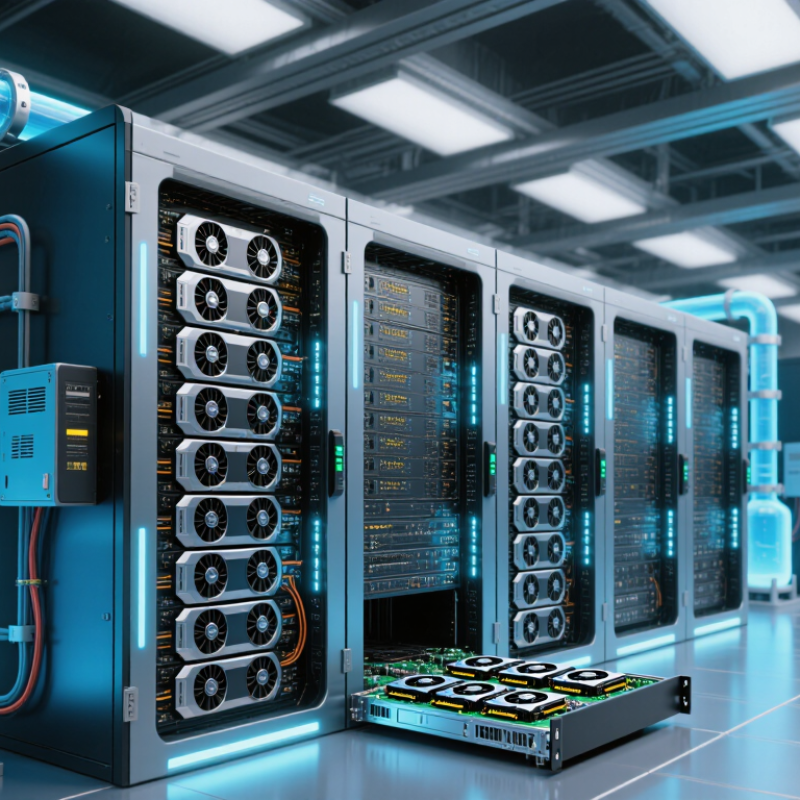
Definition and Scope: How Inference Server Manufacturers Differ from OEMs
What Is an AI Inference Server Manufacturer?
An AI inference server manufacturer designs and validates systems for running trained models in production. Its work goes beyond assembling standard components. Teams select accelerators, memory, networking, cooling, power delivery, and firmware as one tested platform. They measure latency, throughput, uptime, and energy use under realistic workloads. The distinction matters. An OEM, or original equipment manufacturer, typically builds equipment to another company’s specifications, often using a shared chassis or reference design. An inference server manufacturer may take greater responsibility for system architecture, integration, and workload testing. The boundary is not always clear.
Performance needs are changing quickly. Stanford HAI’s 2025 AI Index reports that inference costs for comparable model performance fell more than 280-fold between November 2022 and October 2024. Lower costs can shift buying priorities toward throughput and efficiency, not just peak computing power. The International Energy Agency estimates data centers used about 415 terawatt-hours of electricity in 2024, with demand potentially reaching 945 terawatt-hours by 2030. That makes power use per request a practical design concern. Still, a polished specification sheet cannot prove performance in a real deployment. Cooling, network congestion, and uneven user demand can change the results. Ask how the system was tested, and under what workload.
What Is an AI Inference Server Manufacturer?
Definition and scope: An inference server manufacturer typically focuses on engineering, integrating, validating, and producing server hardware for AI workloads. An OEM typically owns the branded product offer and customer-facing responsibilities. These roles can overlap, and the division varies by business arrangement.
Illustrative role map, not a market survey. A value of 1 indicates a responsibility typically central to that role; 0 indicates it is typically not the primary owner. Actual responsibilities depend on the contract and organization.
Core Architecture: NVIDIA H100 SXM Provides 80 GB HBM and 3.35 TB/s Bandwidth
An AI inference server manufacturer designs systems that move model data quickly and keep accelerators supplied with work. In an SXM configuration, an accelerator with 80 GB of high-bandwidth memory can hold weights, cache data, and intermediate results close to its compute units. Its stated memory bandwidth is 3.35 TB/s. These numbers describe capacity and peak transfer speed, not guaranteed application performance. That distinction matters.
For inference, memory pressure changes with model size, precision, sequence length, and the number of concurrent requests. A larger cache can reduce trips to system memory, while high bandwidth helps serve data to the compute cores. But a server may still slow down when requests arrive unevenly or batching is poorly tuned. Peak figures are not the whole story. Measure real workloads.
System design also shapes whether the hardware can sustain useful throughput. Cooling, power delivery, host memory, and network traffic all affect operation under load. A manufacturer should document tested configurations and explain how performance was measured. I would be cautious about treating a single benchmark as a promise: different models can behave quite differently. Even a tidy specification sheet leaves some practical questions unanswered.
What Is an AI Inference Server Manufacturer? — Core Architecture: 80 GB HBM and 3.35 TB/s Bandwidth
| Architecture Dimension |
Representative Specification |
Inference Relevance |
| Accelerator memory |
80 GB HBM per accelerator |
Stores model weights, runtime data, and—in limits set by the model and software—intermediate activations or cache data. |
| Memory bandwidth |
3.35 TB/s per accelerator |
High bandwidth can help feed the compute units, particularly for memory-bound inference workloads. |
| Memory type |
High-bandwidth memory (HBM) |
HBM is placed close to the accelerator and uses a wide interface to provide high data-transfer rates. |
| Host processor |
Server-class CPU; model and core count vary by system configuration |
Handles request processing, data preparation, scheduling, and other host-side tasks. |
| System memory |
ECC-capable server memory; capacity is configuration-dependent |
Provides host-side working space for services, data pipelines, and model-loading operations. |
| Host-to-accelerator connection |
PCI Express or a supported accelerator interconnect, depending on platform |
Connects accelerators to the host and moves data between system components. |
| Multi-accelerator communication |
Interconnect topology and link bandwidth vary by server design |
Communication links can affect tensor-parallel and other distributed inference configurations. |
| Network interface |
Ethernet or InfiniBand options; port speed depends on the configuration |
Connects the server to clients, storage, and, where applicable, other nodes in a cluster. |
| Storage |
NVMe solid-state storage is a common option; capacity and drive count vary |
Supports operating systems, container images, model files, logs, and local data caches. |
| Cooling and power |
Air or liquid cooling and power-supply capacity depend on the complete system design |
Must be sized for the installed accelerators and other components under the server’s intended workload. |
System Integration: Combining GPUs, CPUs, Memory, Networking, and Cooling
An AI inference server manufacturer turns separate components into a dependable platform for serving trained models. The work starts by matching GPU throughput with CPU capacity, memory bandwidth, and expected request volume. A fast processor cannot fix a memory bottleneck. The system must move model weights and incoming data without leaving compute idle. Small choices matter.
Integration also means checking how components behave together under sustained workloads. Memory capacity affects how many models or requests a server can handle at once. Network adapters and internal links need enough bandwidth to prevent traffic from slowing inference. Engineers can track latency, power draw, and component temperatures during validation. Heat is easy to overlook. Cooling layout must direct airflow across dense components, not just through the chassis. A few degrees can change fan speed and noise.
A reliable manufacturer tests complete configurations, then documents the conditions behind performance claims. Tests should reflect realistic request sizes and concurrency, rather than a single brief benchmark. A test rack cannot reproduce every data center; that limitation deserves attention. Engineers may need to adjust fan curves, cabling, or memory settings after observing real workloads. These trade-offs are not always elegant, but clear measurements help teams make informed choices.
Performance Validation: Measuring Tokens per Second, Latency, and Power
An AI inference server manufacturer should test more than peak throughput. Tokens per second depends on prompt length, output length, batch size, and concurrent users. A useful test fixes these conditions and records them beside each result. Small differences matter. Run the same workload repeatedly, after the system reaches a steady temperature.
Latency needs separate attention. Measure time to the first token and the gaps between later tokens. Report median and 95th-percentile results, not only an average. A low average can hide pauses that users notice. Numbers need context. For example, a short prompt may look excellent while longer requests slow sharply under load.
Power readings should match the workload. Measure energy at the wall, including the server’s fans and memory, and compare it with an idle baseline. Reporting joules per generated token can show whether higher throughput comes with a steep energy cost. Keep the model, software settings, and test duration consistent. There is a catch: one lab setup cannot represent every deployment. Thermal conditions, request patterns, and background tasks can change the outcome. A credible report makes those limits visible, even when they complicate the headline figure.
Facility Efficiency: Uptime Institute Reports Average PUE of 1.56 in 2024
For an AI inference server manufacturer, facility efficiency is not a footnote; it shapes operating costs and usable compute. Uptime Institute’s 2024 Global Data Center Survey puts average data-center PUE at 1.56, compared with 1.58 in 2023. PUE divides total facility energy by energy used by IT equipment. With a 1-megawatt IT load, a 1.56 PUE means about 1.56 megawatts enter the facility. Cooling, power conversion, lighting, and other systems use the balance. Small gains matter. Still, an industry average is not a target for every site.
Lawrence Berkeley National Laboratory’s 2024 United States Data Center Energy Usage Report estimates that U.S. data centers used 176 terawatt-hours in 2023, about 4.4% of national electricity. It projects 325–580 TWh by 2028 as computing demand grows. Server design matters: accelerator utilization, power-supply losses, airflow, and rack density all affect the heat cooling systems must remove. But PUE alone can mislead. Climate and workload differences can change the ratio without improving useful output. Manufacturers should report measured power under clearly stated inference workloads and thermal conditions. One benchmark cannot prove facility-wide savings. Real rooms are messier.
Conclusion
An ai inference server manufacturer designs and validates complete systems for running trained AI models in production. Unlike an OEM that may build equipment to another company’s specification, it coordinates the server’s architecture and integration around inference workloads, balancing compute, memory, networking, storage, and cooling. A configuration may use an accelerator with 80 GB of high-bandwidth memory and 3.35 TB/s of memory bandwidth, but those figures are only part of the system’s performance story.
Effective integration pairs accelerators with suitable CPUs, sufficient system memory, fast interconnects, and cooling designed to sustain demanding workloads. Validation should measure tokens per second, response latency, and power consumption under representative conditions, rather than relying on component specifications alone. Facility efficiency also matters: the reported average data-center PUE was 1.56 in 2024, underscoring the importance of power and cooling overhead. Together, sound engineering, workload-based testing, and operational efficiency define a capable inference server.
 Bexora
